Information for PCOs
 PDF Document
In addition to the restriction on use of restricted agricultural remedies, sales of these remedies will also be limited. The PCO registration requirement in terms of sales apply to the end-user of the product (farmer/farmworker) only. If a supplier sells a remedy to a distributor/agent who sells the remedy to the end-user, the distributor/agent does not need to be registered as a PCO, only the end-user. Distributors/agents must however ensure that the person they are selling restricted remedies to is registered as a PCO within the applicable field of certification related to the remedy being sold. Thus, if a remedy is being sold for use in agriculture (excluding aerial application or fumigation which has their own fields of certification), the PCO must be certified in the field of “agriculture and forestry” (please refer to the section on Pest Control Operators for more information on the fields of certification).
In accordance with the “Regulations under the hazardous substances Act 15 of 1973”, various measures are already in place for the handling and trading of Group I hazardous substances. Agricultural remedies classified as Group IA hazardous substances include aluminium and zinc phosphide, and those classified as Group IB hazardous substances include all chemicals falling within Class 6.1 (toxic substances) according to the UN Recommendation on the Transport of Dangerous Goods Model Regulations, specified in Appendix E and F of the South African Bureau of Standards Code of Practice 10228. “Restricted agricultural remedies” as defined in the “Regulations relating to agricultural remedies” are predominantly acutely toxic and will thus also be regulated under the “Hazardous Substances Act 15 of 1973”. Therefore, in addition to the requirements already stipulated in the Hazardous Substances Act for Group I hazardous substances, the following will be applicable to “restricted agricultural remedies”:
- A “restricted agricultural remedy” may only be sold to a registered PCO qualified in the specific field of application. Thus, a sale of a restricted remedy may only be made to a person, who upon purchase, provide proof that they are sufficiently qualified and registered to administer the remedy.
- On initial purchase, the registered PCO must provide to the supplier/distributor of the remedy a certified copy of their PCO registration certificate which will be kept on file by the supplier/distributor.
- If the person responsible for sales on a farm is not the person who is registered as a PCO and applying agricultural remedies in the field, it is possible for a designated person who is not registered as a PCO to purchase a restricted agricultural remedy on behalf of a registered PCO. In this case, upon first purchase, the registered PCO will accompany the representative responsible for sales to the supplier/distributor in order for the supplier/distributor to get acquainted with the PCO and sales representative. Along with a certified copy of the PCO registration certificate, the PCO will provide a signed letter to the supplier/distributor giving consent to the sales representative to purchase the restricted remedy on their behalf. These documents will be kept on file by the supplier/distributor.
Pest control operators are also regulated under Act No. 36 of 1947, and a person must apply to the Department of Agriculture, Land Reform and Rural Development (DALRRD) to become registered. Pest control operators are certified in specialised areas of pest control and the following fields of registration are available:
- Fumigation
- Aerial application
- Agriculture and forestry
- Industrial vegetation and noxious weeds
- Landscape
- Supplemental and/or remedial wood treatment
- Structural
- Any other relevant specialisation
Each field necessitates specialised training and certification to ensure that the PCO has the appropriate knowledge and skills to safely and successfully apply the restricted remedy. As a result, a PCO certified to conduct fumigation may not administer structural pest control remedies unless obtaining additional structural pest control certification. Remedies that are registered for use in agriculture (with the exception of aerial application and fumigation), will require a PCO to be certified in the field of “agriculture and forestry”.
The process for registration as a PCO is circulated annually by DALRRD. Below are some of the key requirements:
- A person must do a course to obtain a national certificate in pest control from a relevant accredited academy.
- The person must obtain practical experience under a registered PCO for 6 to 12 months, depending on the relevant field of certification.
- A person with a diploma or degree in a biological field such as entomology, pathology, crop protection, weed science, or any relevant qualification may be exempted from the requirement of practical experience depending on prior experience.
- The person should undergo a medical examination and must submit the template report completed by a qualified medical practitioner with their application.
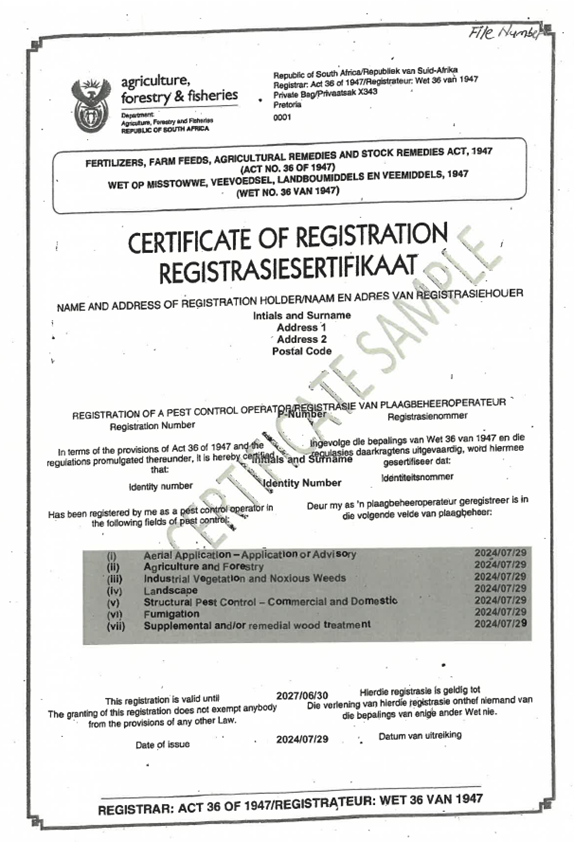
Following the approval of the PCO application, the certificate will be valid for a period of three years. To retain the certificate, the PCO must submit a renewal application before the validity term expires. It is essential that PCOs provide evidence that they are competent and actively working in the field in which they have obtained the certificate (please refer to Figure 2 for an example of a PCO registration certificate).
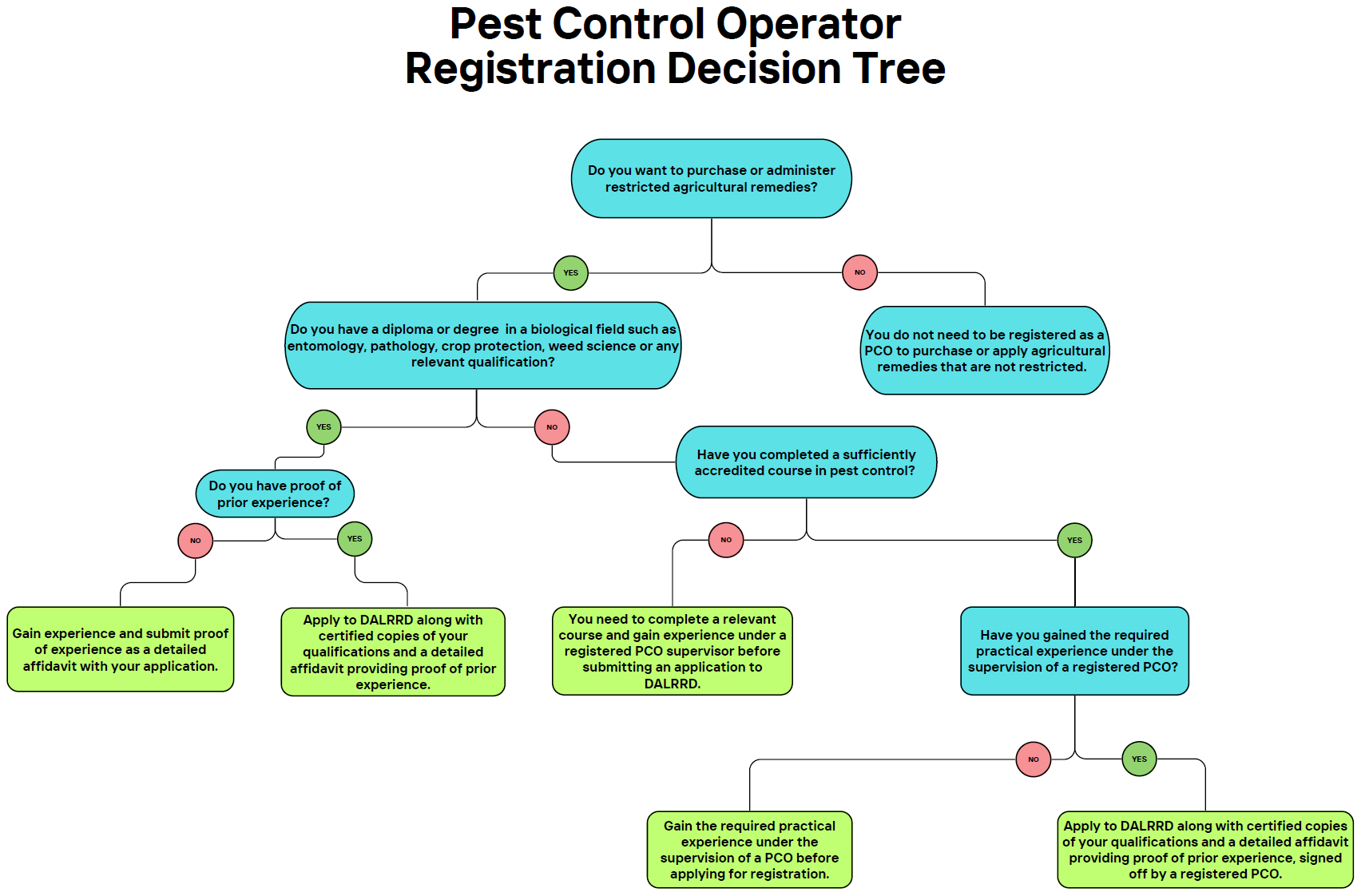
Figure 2: Example of a certificate of registration as a Pest Control Operator under Act No. 36 of 1947.